Scooler
Redesigning an AI-Powered University Application Platform
Overview
Scooler is an AI-powered platform designed to help students discover universities, understand their academic pathways, and complete applications with greater confidence and efficiency.
I joined as the founding product designer at a critical stage. The team had already built an ambitious MVP, but the product experience was fragmented, over-scoped, and difficult for students to navigate. My role was to audit the existing experience, define a clearer product strategy, and redesign the platform around the most valuable student journeys.
Team
Founders, Engineers, Marketing
Responsibilities
- Product strategy
- UX research
- Information architecture
- Interaction design
- Design systems
- Usability testing
- Marketing website design
The Challenge
The initial MVP attempted to solve multiple student problems simultaneously through a collection of disconnected AI-powered experiences.
As a result:
- Navigation lacked clarity
- Key student goals required too many steps
- AI features felt isolated rather than integrated
- The product contained more screens and complexity than required for an early-stage launch
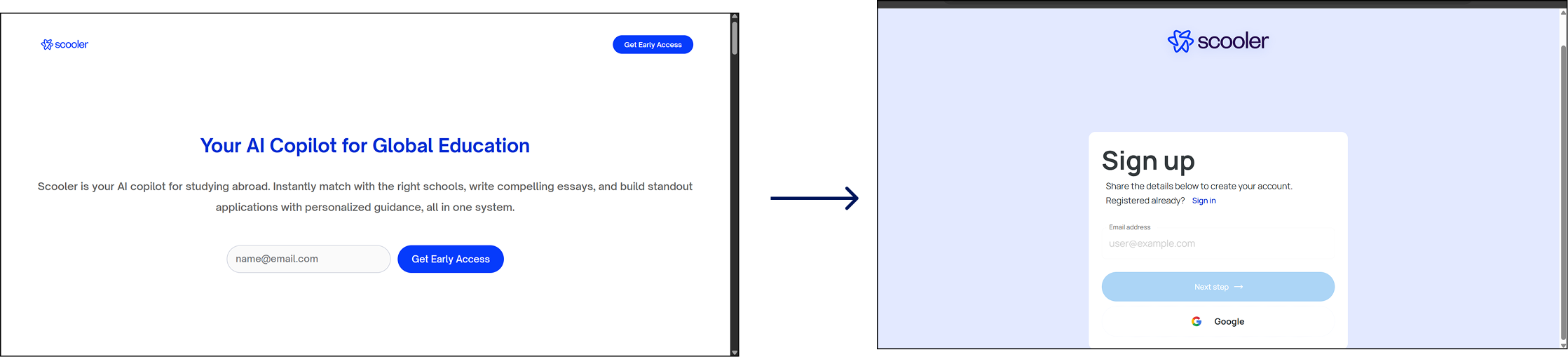
What worked
- Clear value proposition at entry
- Collected enough context to personalise early
What didn't
- Too many steps before the student reached the product
- Required information upfront that could have been deferred
- No progress indicator — felt endless
My Approach
1. Product Strategy Matrix
Before redesigning, I mapped user goals and competitive positioning to define where Scooler could deliver the most meaningful differentiation.
2. Auditing and Simplifying the MVP
I conducted a full audit of the existing product experience, mapping user journeys, identifying redundant flows, and evaluating where students encountered friction.
Across three design iterations, I reduced the overall screen count by approximately 35%.
3. Reimagining the Role of AI
One of the most significant product decisions involved redefining Skye, Scooler's AI assistant.
Initially, Skye existed primarily as a chatbot.
I proposed repositioning Skye as the platform's central intelligence layer — a control center that could surface recommendations, clarify pathways, guide decisions, and coordinate actions throughout the product.
Key Experiences Designed
Designed a guided onboarding experience that collected student goals, academic interests, qualifications, and preferences.
Protected Content
This content is protected for confidentiality purposes. Please enter the password to continue viewing.
Web Design
Marketing Website
Beyond the product itself, I designed the company's marketing website.
Impact
Product Outcomes
- Reduced overall screen count by 35%
- Prioritized five high-impact user journeys
- Repositioned AI as the platform's core guidance layer
- Validated key product decisions through usability testing
- Delivered end-to-end experiences across discovery, planning, application preparation, and submission
Navigation clarity
was 54%
School-match confidence
was 41%
Understanding of AI guidance
was 38%
Overall user satisfaction
was 3.1
Reflection
This project reinforced the importance of treating AI as a product capability rather than a standalone feature.
The most valuable outcome wasn't adding more AI functionality — it was creating a clear experience where AI actively helped students progress toward their goals.