
Pathfinder
AI-enabled career guidance for high schools
Role
Product Design Manager
Timeline
2023 – 2024
Industry
EdTech — K-12
$60K
Beta revenue
$150K
Pre-seed round
$500K
Seed round
A broken system no one talks about
“$2.87 billion — spent every year by American parents on private college advisors to fill a gap public schools should not have.”
1 in 3
US high schools have a dedicated college counselor
400:1
Student-to-counselor ratio in under-resourced schools
$2.87B
Spent annually on private advisors
The college application process is the most consequential academic milestone most students face — yet the system designed to guide them through it is structurally under-resourced. Pathfinder was built to close that gap with AI.
Full ownership, end to end
As Product Design Manager I owned the entire design surface — from early strategy through to launch — while coordinating across engineering, research, and external contributors.
Strategy & Planning
Owned the product roadmap, defined OKRs per quarter, and aligned stakeholders from day one through the Series A.
Research & Discovery
Led 56 user interviews across school counselors and students, synthesising findings into actionable design principles.
Design (0 to 1)
Built the complete design system and shipped the product from zero screens to a production-ready experience across two portals.
AI Product Design
Designed Melon — the AI character system — including interaction states, voice and tone, and contextual trigger logic.
Testing & Iteration
Ran structured usability studies via Maze.co, achieving 88% task success and iterating to a 4.8 / 5 path-completion rating.
Marketing & Sales Enablement
Created pitch deck assets, live demo flows, and sales collateral that supported the $500K Series A raise.
Double Diamond — quarterly
The project followed a structured Double Diamond framework mapped across four quarters, with each phase having clear OKRs to keep design and engineering aligned.
Validate the problem space through stakeholder interviews, synthesise research into personas, and align the founding team on a product vision.
Ship lo-fi to hi-fi across both portals, establish design system foundations, and complete two rounds of school partner validation.
Run Maze.co usability studies, iterate on the counselor dashboard and Melon AI, and finalise the canvas interaction model.
Ship V1 to 5 committed schools, collect live feedback, and support the Series A with design-led demo materials.
Talking to the people who live in the problem
Before touching Figma, I spent weeks in the field. Cold outreach to school administrators, career counselors, and students across the US surfaced the patterns that became Pathfinder's design foundation.
105
Cold contacts to school administrators and counselors
56
In-depth user interviews conducted
20+
Early sign-ups before the product existed
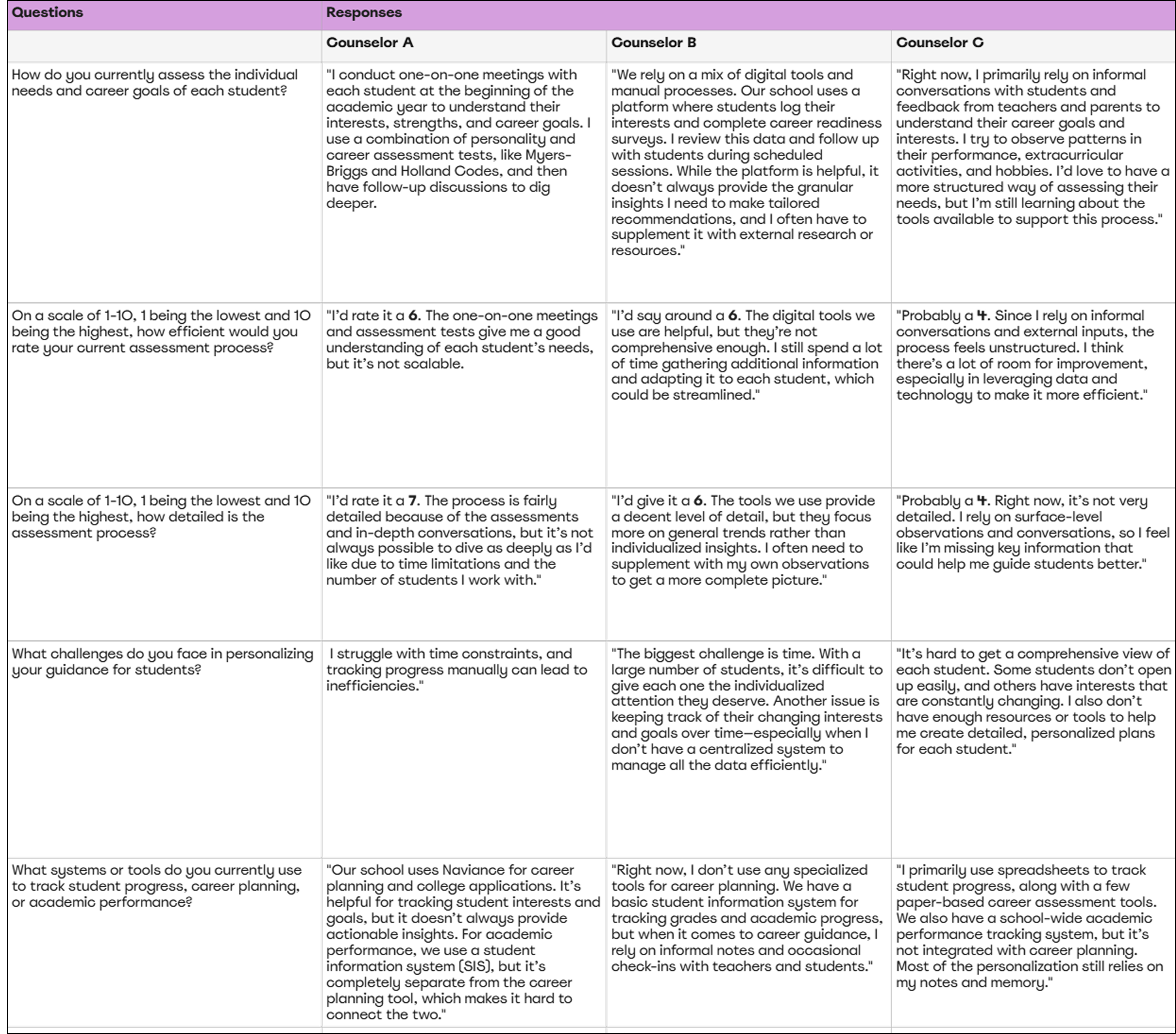
Counselor Interview Response Analysis
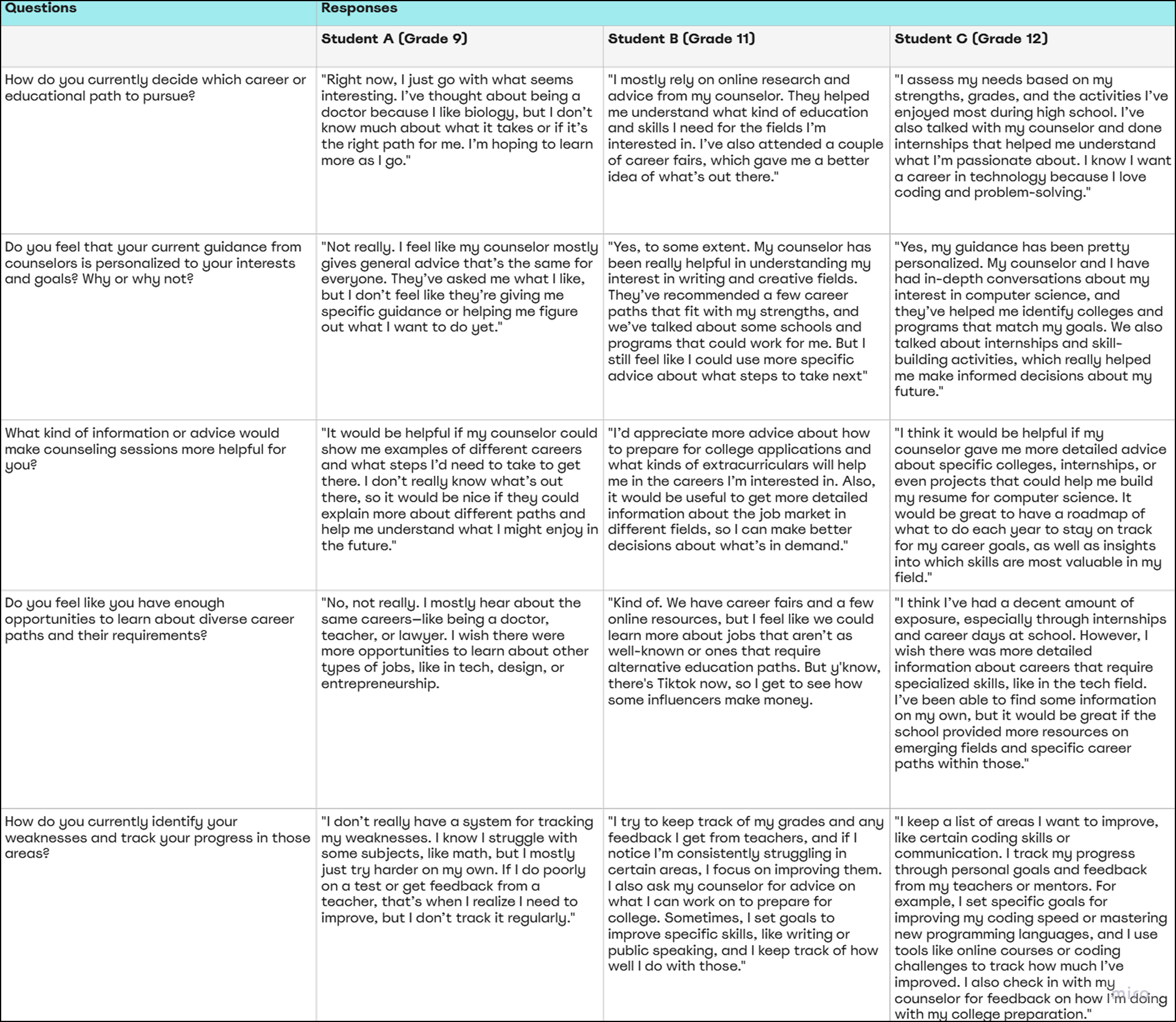
Student Interview Response Analysis
Three problems, one product
Counselors carry an impossible load
The average counselor manages 400+ students with spreadsheets and instinct. Personalised guidance is structurally impossible at that ratio without intelligent tooling.
Students navigate blind
Most students have no clear, step-by-step roadmap for the application process. Without structure, critical milestones get missed — not from laziness, but from a lack of visibility.
Wealth determines access
The $2.87B private advising industry exists because public schools cannot fill the gap. Pathfinder was built to democratise guidance that was previously gatekept by income.
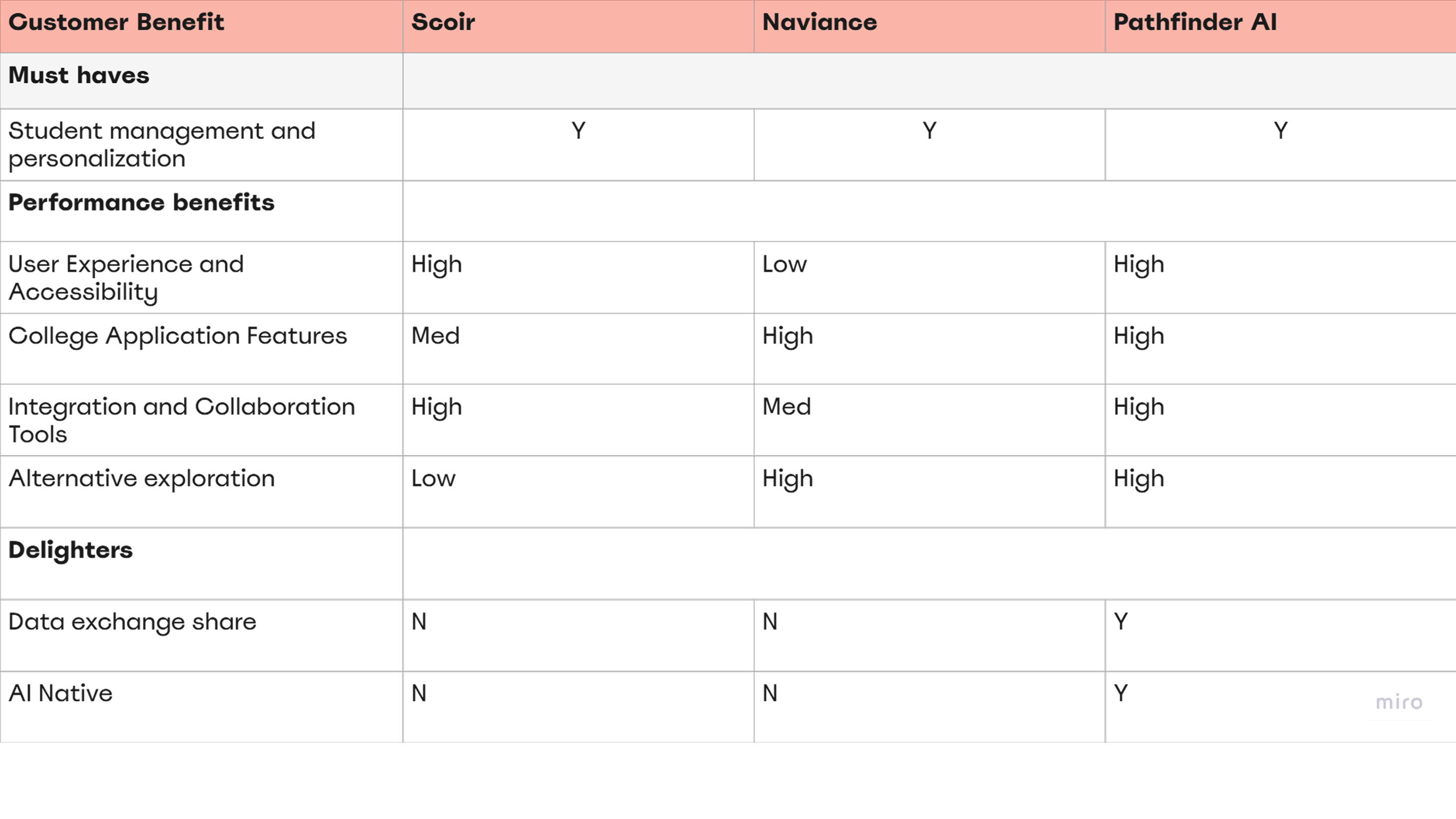
Competitive Analysis Grid: Scoir vs Naviance vs Pathfinder
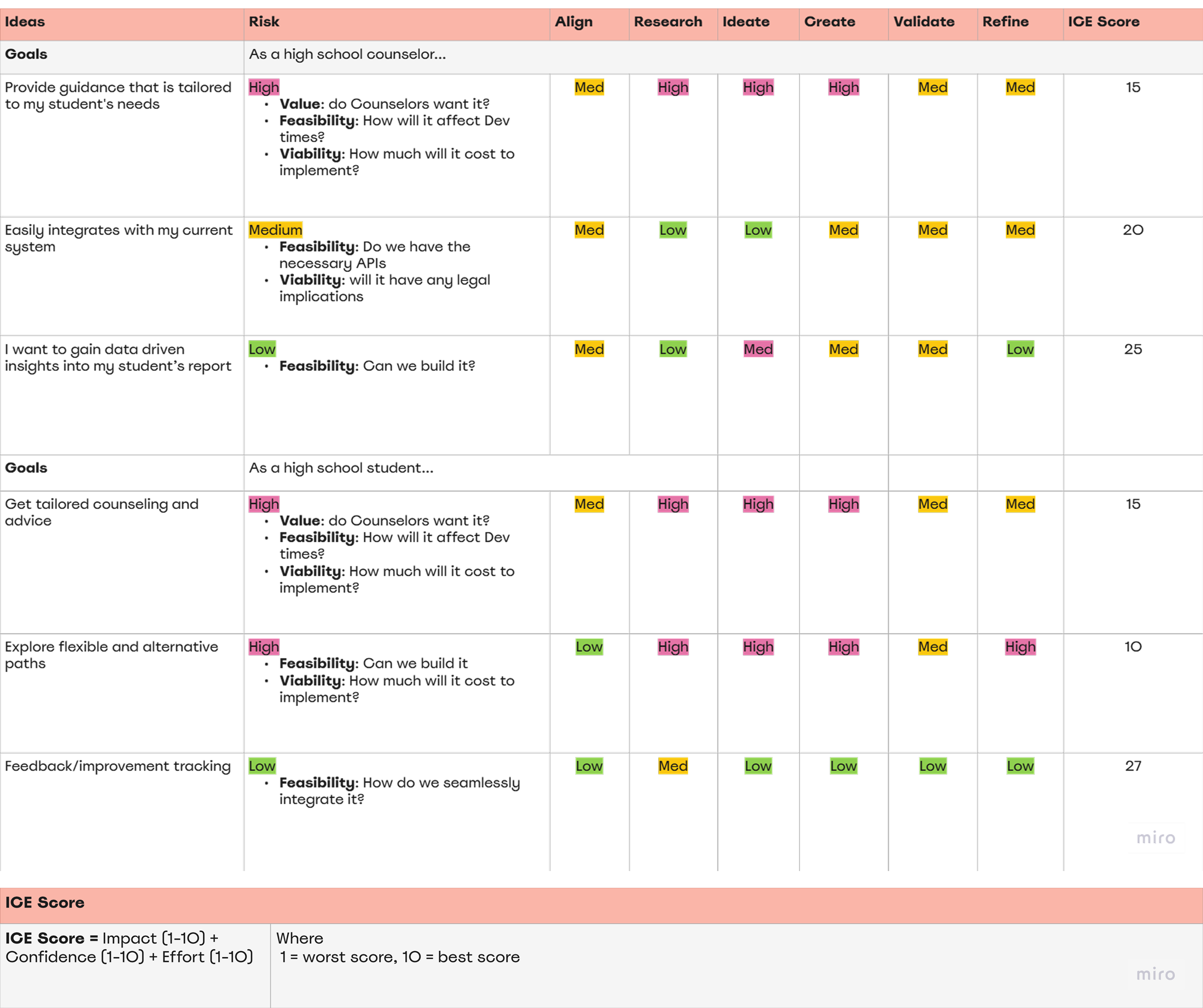
ICE Scoring Matrix
Two users, two completely different needs
Research converged on two primary personas: Toby Snow, a junior student overwhelmed by the application process, and Julie Warren, a school counselor managing more students than any one person reasonably can.
%20%26%20Julie%20Warren%20(Counselor).png)
User Personas: Toby Snow (Student) & Julie Warren (Counselor)
From whiteboard to wireframe
Ideation started with physical whiteboarding to map information architecture across both portals, then moved into rapid lo-fi exploration in Figma to validate the core layout decisions before committing to high fidelity.
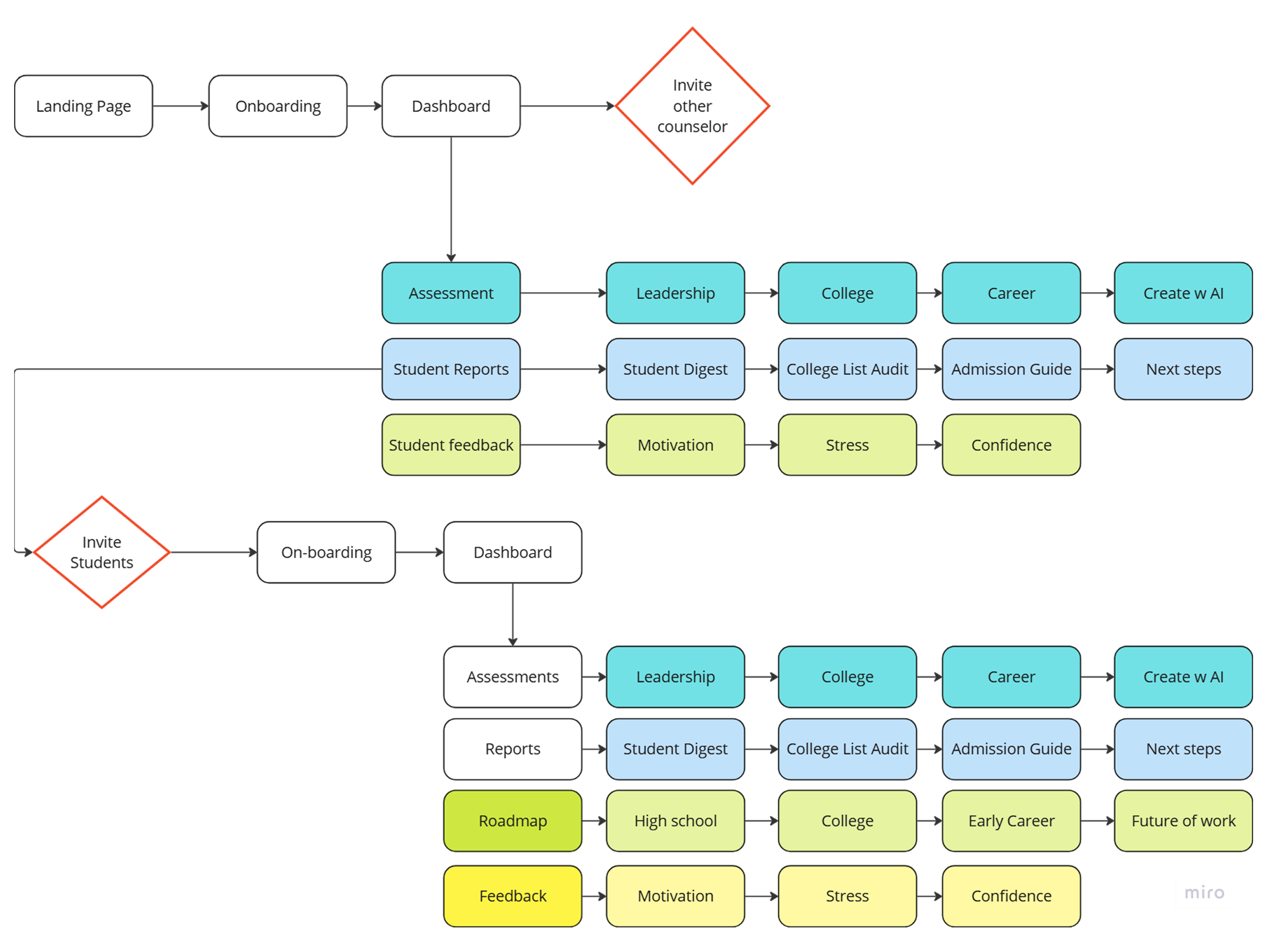
Information Architecture & Site Flow
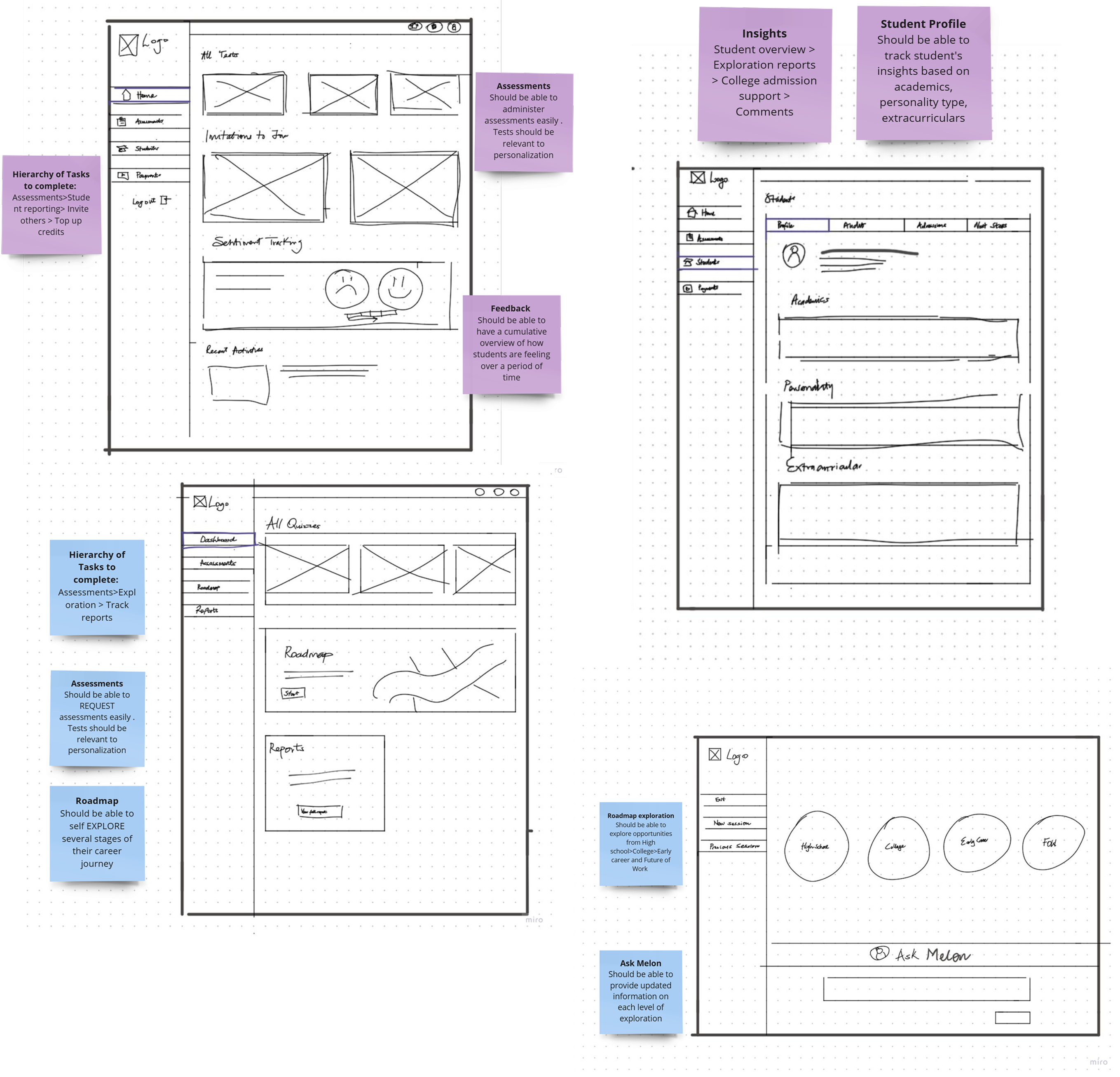
Lo-Fi Whiteboard Sketches
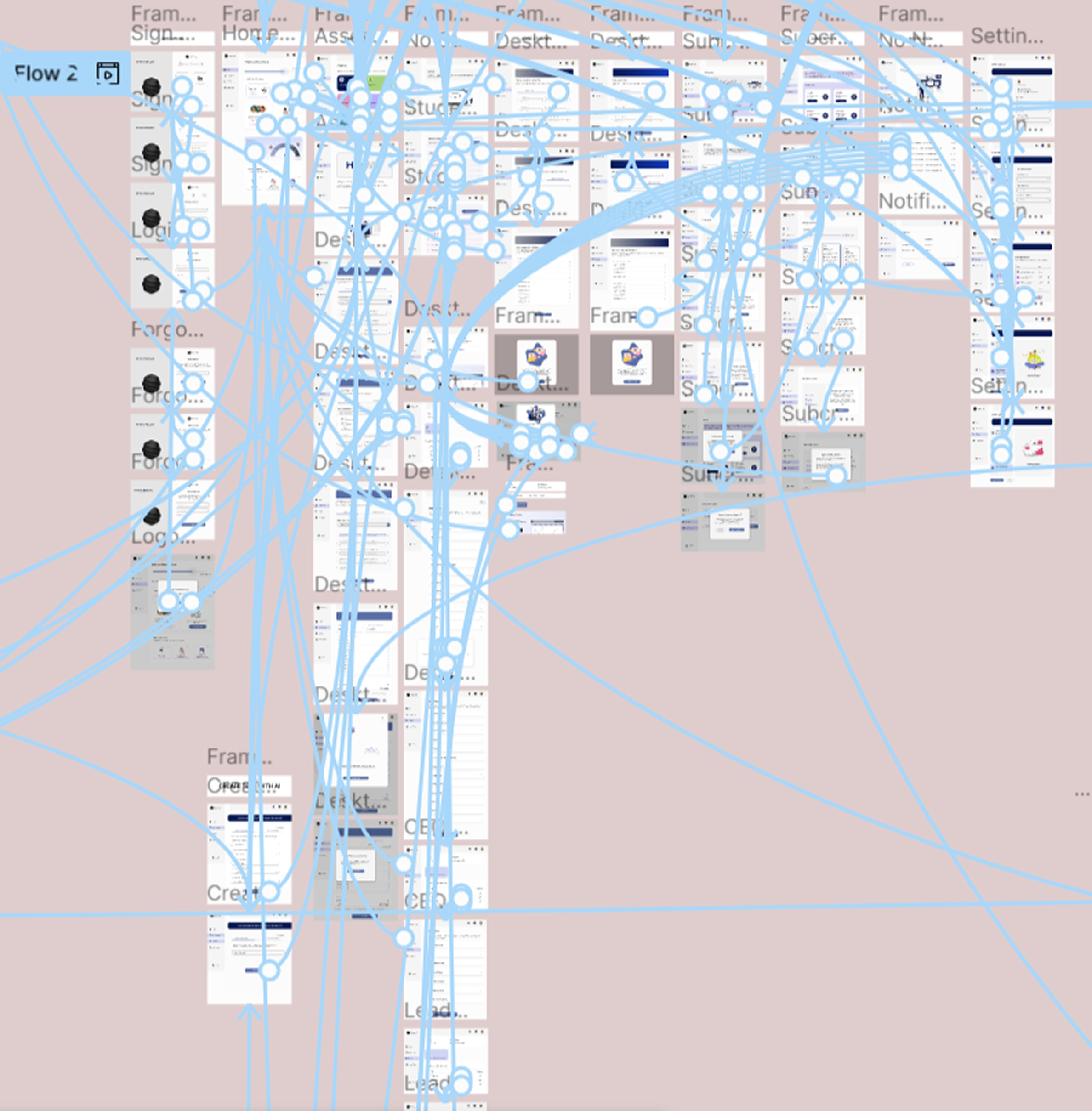
Figma Lo-Fi Canvas Overview
Two portals, one design system
The product ships as two distinct experiences — a counselor portal for managing students at scale, and a student portal built around the canvas roadmap — sharing a unified component library and visual language.
Counselor Portal mid fidelity
Counselor Portal — Interactive Prototype
Student Portal mid fidelity
Student Portal — Interactive Prototype
The AI that feels like a teammate
Melon is Pathfinder's AI character — a 3D companion that lives inside the student portal and communicates guidance through three emotional states rather than generic chat responses. The goal was to make AI feel warm, contextual, and purposeful.
.png)
Melon AI — 3D Model & Expression States (Happy, Curious, Warning)
Melon animates into a smile state with a short celebratory message to reinforce positive student behaviour.
Melon nudges the student with a gentle reminder and surfaces the recommended next action to re-engage them.
Melon shifts to an alert expression with a prominent action card and a visible countdown to the deadline.
The design decisions that mattered most
Student Roadmap
Replaced a static checklist of circles with a visual canvas tree — giving students a spatial sense of their full journey and how each task connects to the next.
Counselor Dashboard
Replaced passive data cards with the Melon multimodal widget — surfacing the highest-priority students with context so counselors can act in one click, not five.
Validated before launch, not after
Structured usability testing via Maze.co with students and counselors across 3 school partners gave us the data to iterate with confidence before shipping V1.
88%
Task success rate across usability studies
80%
Path completion rate in guided test sessions
4.8/5
Average student rating for roadmap clarity
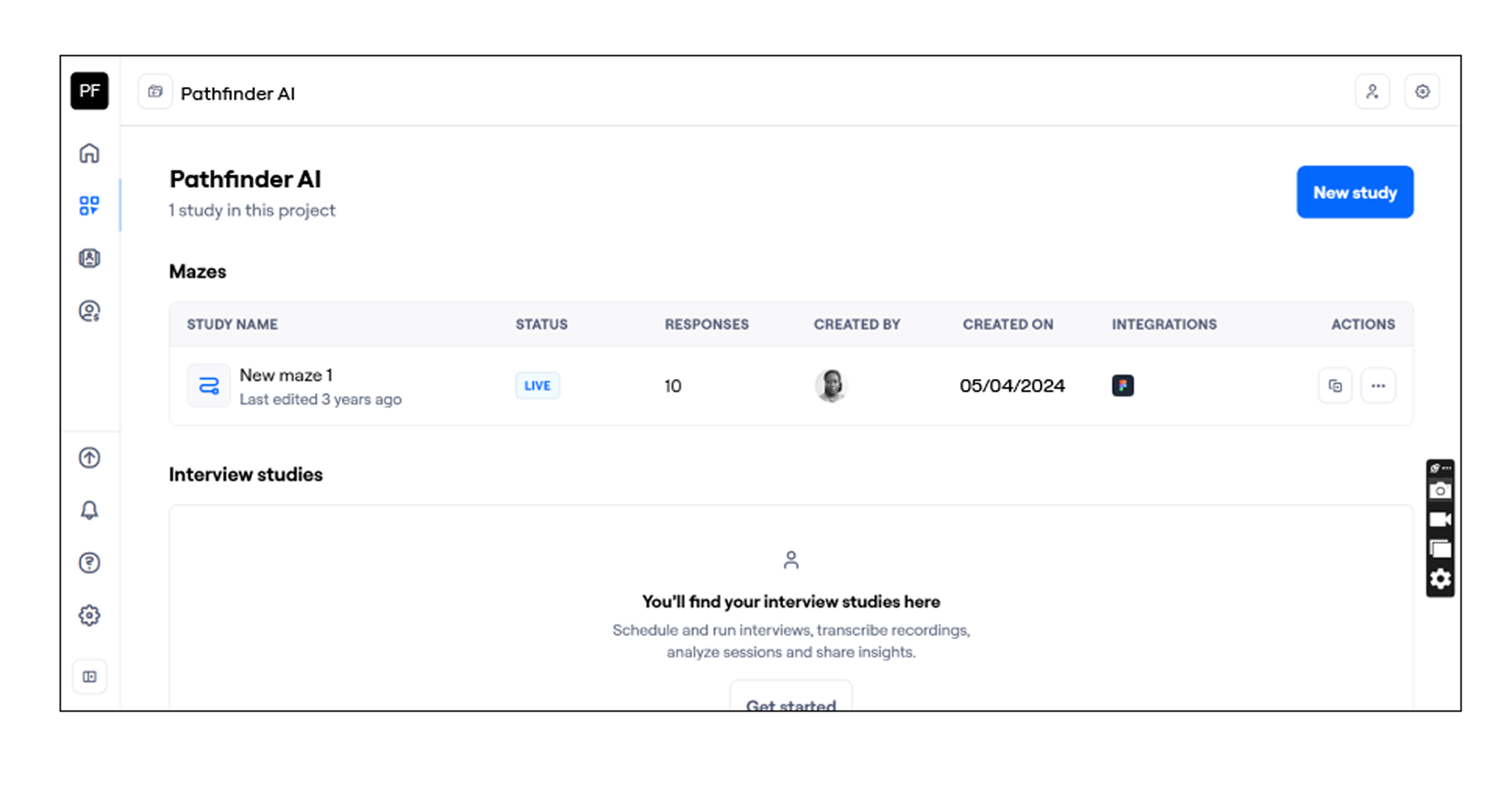
Maze.co Usability Test Dashboard Screenshot
Built to scale, not just to ship
The design system was established in Q2 and extended continuously through launch. Typography, colour, spacing, and component decisions were documented in Figma with engineering handoff in mind from day one.


Shipped to 5 schools. Helped close a round.
Pathfinder launched to 5 committed partner schools in Q4. The product experience — and the design process behind it — played a direct role in securing the Series A.
+22%
UX score vs. category benchmark
80%
User satisfaction across both portals
$500K
Series A secured post-launch
4.8★
Average rating from school partners
What building 0 to 1 actually taught me
Know your technical constraints before you design
The canvas nearly didn't ship because I validated feasibility too late. I now treat the tech lead as a design collaborator from ideation, not a handoff recipient.
Managing external contributors requires design leadership, not just design skills
Bringing in an external canvas developer shifted my role into translating between design intent, business timelines, and a contractor's workflow. It made me a stronger design manager.
A delayed launch with 5 committed schools beats a rushed launch with none
We launched later than planned but with real schools actively giving feedback. Protecting V1 quality — even at the cost of timeline — was the right call.
Protected Content
This content is protected for confidentiality purposes. Please enter the password to continue viewing.